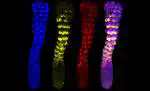
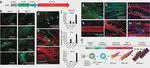
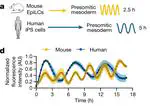
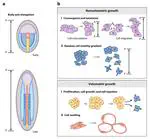
Building on our understanding of somite development, we developed a protocol to efficiently differentiate murine and human pluripotent stem cells (PSCs) into PSM in vitro. Using reporter lines expressing fluorescent markers, we demonstrated that the oscillations of the segmentation clock can be reproduced in vitro from human iPS cells differentiated into PSM, thus identifying the human segmentation clock for the first time. These studies highlighted the significant level of conservation of this mechanism in mammals. We then developed three-dimensional (3D) culture systems of human iPS cells that recapitulate somite formation, demonstrating the remarkable self-organizing properties of these structures in vitro. We developed two 3D differentiation systems for human paraxial mesoderm one that recapitulates embryonic elongation in vitro (segmentoids) and the other that allows the production of human paraxial mesoderm capable of segmenting into somites in vitro (somitoids). The human PSM generated in vitro using these protocols is very similar to that of mouse embryos, making it a remarkable model for studying somitogenesis in humans, which would not be feasible with embryonic tissues. Using these in vitro systems, our work challenged the classical view of the antero-posterior compartmentalization of somites, a crucial process for the formation of the vertebral column and the segmentation of the peripheral nervous system. We have shown that this process relies on a cellular sorting mechanism periodically triggered by the segmentation clock, thus ensuring the coordination of somite formation and their anteroposterior compartments.